








 Discover our expertise


 Discover our dedicated team offer


Development of machine learning solutions with Scikit-Learn


01
Scikit-Learn, a Reference Framework for Machine Learning Projects
Scikit-learn is an open-source Machine Learning library dedicated to data analysis and modelling. Developed in Python, it provides a set of algorithms and tools that enable the design of reliable, readable, and reproducible predictive models.
Designed for robustness and maintainability, Scikit-learn integrates naturally into modern data architectures. It helps structure scalable projects by facilitating reproducibility of processes and ensuring reliable results. This approach makes it a relevant foundation for data initiatives focused on performance and decision-making.
Adopting Scikit-learn means relying on a proven framework to transform data into concrete levers for optimisation and decision support. It enables organisations to move beyond experimentation and deploy models that are operational, sustainable, and aligned with business objectives.
02
Scikit-learn is widely adopted in professional environments for its maturity, readability, and performance.
03
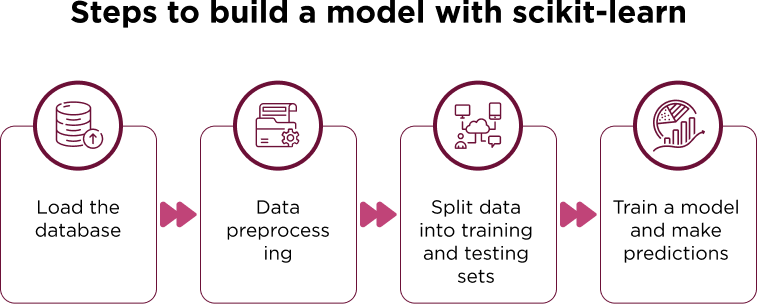
An effective Machine Learning project relies on a clear methodological framework in which Scikit-learn plays a structuring role:
- Definition of business objectives and performance indicators
- Data collection, preparation, and validation to ensure reliability
- Selection and comparison of models based on criteria suited to the business context
- Performance evaluation and iterative improvements
- Implementation of practices that ensure reproducibility and maintainability
- Documentation and clear structuring of work to facilitate team adoption
04
Scikit-learn applies to a wide variety of business contexts:
- Prediction and scoring to anticipate behaviours, risks, or performance
- Segmentation and clustering to identify customer profiles, patterns, or business categories
- Anomaly detection and identification of unusual events in large datasets
- Decision support through models integrated into business processes
- Automation of processes and data-driven decision-making
- Cross-functional applications: marketing, finance, industry, supply chain, operational management


